
 By
By 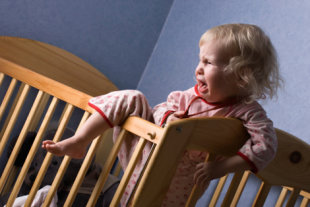
Is crying it out hurting your child?
Most sleep-deprived parents get to the point where they're willing to try almost anything in order to get a good night's rest. While some decry it as cruel, others have had success with the "cry it out" method -- teaching babies to "self-soothe" by letting their nighttime crying go unanswered.
But is "crying it out" about establishing independence? Or is it just a way of making those early years easier for parents?
In an article published this week in Psychology Today, one researcher says that crying it out could be dangerous for children, leading to a lifetime of harm.
"A crying baby in our ancestral environment would have signaled predators to tasty morsels," writes Darcia Narvaez, an Associate Professor of Psychology and Director of the Collaborative for Ethical Education at the University of Notre Dame. "So our evolved parenting practices alleviated baby distress and precluded crying except in emergencies."
When babies are stressed, their bodies release the hormone cortisol, which can damage or even destroy neurons in their still-developing brains, researchers at Yale University and Harvard Medical School have found. That can lead to a higher incidence of ADHD, poor academic performance, and anti-social tendencies.
Human babies are hardwired for near-constant holding, breastfeeding, and having their other needs met quickly -- the hallmarks of Attachment Parenting, Narvaez points out -- in order for their brains to develop properly. Even Dr. Richard Ferber, whose sleep-training method is commonly called the Cry It Out Method, says that he never intended parents to completely ignore their babies nighttime tears.
"I've always believed that there are many solutions to sleep problems, and that every family and every child is unique," he said in an interview with BabyTalk. "People want one easy solution, but there's no such thing. I never encouraged parents to let their babies cry it out, but one of the many treatment styles I described in my book is gradual extinction, where you delay your response time to your baby's wakings. I went to great pains in the second edition to clarify that that treatment is not appropriate for every sleep issue, of which there are many."
What he does encourage is teaching children to soothe themselves during normal nighttime wakings. But many parents extend his advice to include all bedtime-related crying. That's the type of crying it out sets kids up for stress-related problems, trust issues, anxiety disorders, reduced brain function, and a lack of independence, Narvaez writes. And since the problems are on a genetic level, they can't necessarily be fixed later in life.
"In studies of rats with high or low nurturing mothers, there is a critical period for turning on genes that control anxiety for the rest of life," Narvaez writes. "If in the first 10 days of life you have low nurturing rat mother (the equivalent of the first 6 months of life in a human), the gene never gets turned on and the rat is anxious towards new situations for the rest of its life, unless drugs are administered to alleviate the anxiety."
Could a lack of nurturing explain our "Prozac Nation?" Narvaez points out that she's witnessed the long-term physical effects of it firsthand.
"I was raised in a middle-class family with a depressed mother, harsh father and overall emotionally unsupportive environment -- not unlike others raised in the USA," she writes. "I have only recently realized from extensive reading about the effects of early parenting on body and brain development that I show the signs of undercare -- poor memory (cortisol released during distress harms hippocampus development), irritable bowel and other poor vagal tone issues, and high social anxiety."
The lack of nurturing, and the prevalence of parents who put their own needs in front of their kids', may be to blame for the mental and physical health problems that are plaguing the United States now.
"If we want a strong country and people," she writes, "we've got to pay attention to what children need for optimal development."
yup! I'm psart of AP (attachment parenting) and its all about this. great to read about this stuff
ReplyDeleteGood to see people getting more aware to this... and it`s just plain common sense.
ReplyDeleteIt's too bad that even though Dr. Ferber announced that he didn't mean it to go that far, still parents are trying to go that Cry It Out route. Poor babies!!
ReplyDeleteI am ALL for crying it out. Only because I have a child who went through a faze where NOTHING we did calmed her, and i mean NOTHING. Finally got sick of it, let her cry it out for 3 days, never for more on her own then 5 mins, but after that she submitted to bedtime, and instead of crying it out now,i sit with her and she is asleep usually within 15 mins. I posted this link on my FB page as I agree with most of it. How ever i disagree that its not, NOT, the way to go. For some kids, self soothing is their only option. At the same time I don't think its an only option for all kids, nor should it be the 1st option, if you pay attention to your child, you'll figure out what they need with out screaming. If you are blessed with an overly stubborn child who hates sleep, like mine. Self soothing is wonderful!
ReplyDeleteYes, I agree with you there. If the child is stuborn like that, or has a bad temper, maybe leaving them alone for a while is best. Each child is different and as long as you follow your instincts I think mothers generally do fine.
ReplyDeleteAgree too, it should never be done as a first option... that`s just mean and lazy.
ReplyDelete